It was a gray Tuesday in the winter of 2011.
Lunchtime at Marlene’s diner had just ended, leaving behind only the hum of the refrigerator and the soft clink of coffee cups.
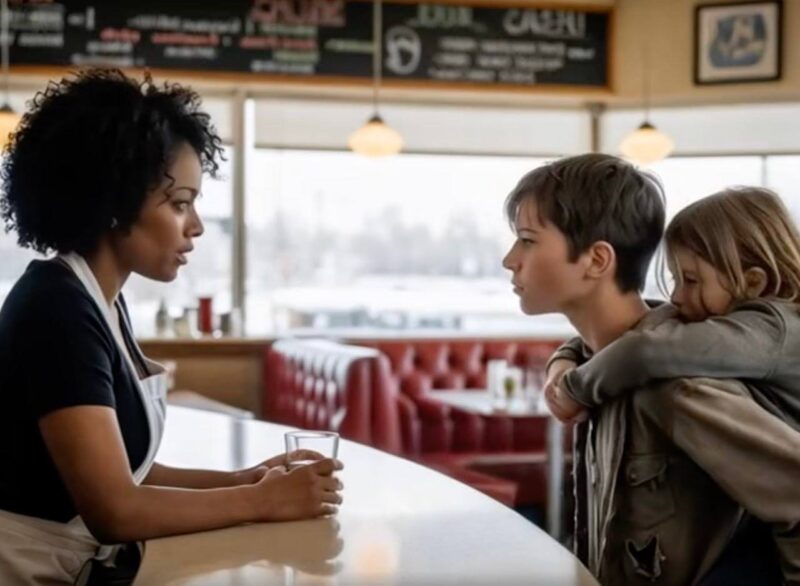
Marlene Carter was wiping down the counter when the door opened, letting in a gust of cold air.
Two figures appeared on the threshold: a teenager with a thin face, wearing worn-out sneakers, carrying a smaller girl on his back.
The girl’s hair was messy, her face hidden in her brother’s shoulder, as if she wanted to protect herself from the world.
They didn’t go to a table. The boy went straight to the counter, tense, as if he expected to be sent away.
“Can I… get her some water?” he asked softly.
Marlene noticed her hands were shaking.
She looked at the girl—no more than six—and the boy’s torn sweatshirt.
Without asking any questions, he filled two mugs not with water, but with hot chocolate, and placed them in front of them.
“Looks like you guys need a real lunch,” he said simply.
— We have no money — the boy exhaled.
“I didn’t ask,” Marlene replied, going into the kitchen.
A few minutes later, she brought out two steaming plates of chicken and mashed potatoes.
The boy hesitated, but the girl began eating immediately, holding the fork as if it were a treasure.
When the boy finally tasted it, his eyes filled with tears—not from the heat of the food, but from something much deeper.
They ate in silence, then thanked each other softly and left.
Marlene never knew their names.
The last image he had was the boy’s hand, protecting his sister as they disappeared into the cold.
That night, as she closed the restaurant, Marlene thought of them. She wanted to believe they had found a warm place.
She didn’t know that that simple gesture—food and a little kindness—would one day return in an unexpected way.
In 2023, Marlene’s life changed. She no longer ran the diner—arthritis made long shifts impossible.
Now she lived alone in a small house on the outskirts of town, tending to her garden and sometimes entertaining friends.
One spring day, while watering the flowers on the balcony, he heard the deep roar of an engine.
In front of the house, a shiny black Mercedes stopped.
Marlene frowned: none of her acquaintances drove cars like that.
A tall man dressed in an expensive suit got out of the car.
He took off his sunglasses and smiled.
“Mrs. Carter?” he asked.
“Yes,” she replied cautiously.
“You probably don’t remember me,” he said warmly. “But twelve years ago, you gave a hot lunch to a homeless boy and his little sister.”
You said you didn’t need to pay.
Marlene looked at his face. And recognized it—the same eyes, only now there was no longer fear, but trust.
— Daniel? — he whispered.
He nodded.
— And this… — he pointed to the car — is Emily.
A young woman got out of the passenger side. Her smile was shining.
She was healthy, well cared for, and exuded calm and strength.
—We never forget what you did—Daniel continued.
—That night changed everything. I swore I would find her.
They sat in Marlene’s kitchen with a cup of coffee while Daniel recounted what happened next.
After that night, a church offered them temporary shelter.
Then they went to an orphanage and, despite the difficulties, they remained together.
Daniel studied hard, won a scholarship, and later founded his own IT company.
Emily had recently finished nursing school and became a nurse.
“What you gave us was hope,” Emily said, her voice trembling.
— It wasn’t just a meal. You treated us like people.
Daniel placed an envelope on the table.
Inside were documents—Marlene’s house was now fully paid for, the mortgage paid off.
“I know you didn’t expect anything in return,” he said. “But you changed our lives. Let us change yours.”
Marlene’s eyes filled with tears.
“I didn’t do anything special,” he whispered.
“Yes, you did,” Daniel replied. “You were the first person to believe we deserved help. And that was enough.”
When they left, the black Mercedes no longer looked strange in front of the small house.
It became a reminder: a simple act of kindness can echo for years… and come back to you when you least expect it.