In the winter of 1943, when the Lviv ghetto was gripped by hunger, disease, and fear, an unnamed Jewish mother made a choice that would change the course of history—not for herself, but for her newborn son.
It was a choice born of desperation, shaped by courage, and remembered decades later as one of the quietest and yet most profound acts of love.
By then, life inside the ghetto had descended into horror. Food was scarce, deportations were constant, and each day brought another trainload of souls destined for the death camps.
For parents, the nightmare was relentless: how to keep a child alive in a world designed to erase them.
This mother, faced with the inevitable, found an impossible crack of hope.
She had made contact with Polish sewer workers—ordinary men who took extraordinary risks guiding Jewish families through the underground tunnels beneath the city.
The sewers were dark, fetid, and suffocating, but they offered what the ghetto could not: the possibility of survival.
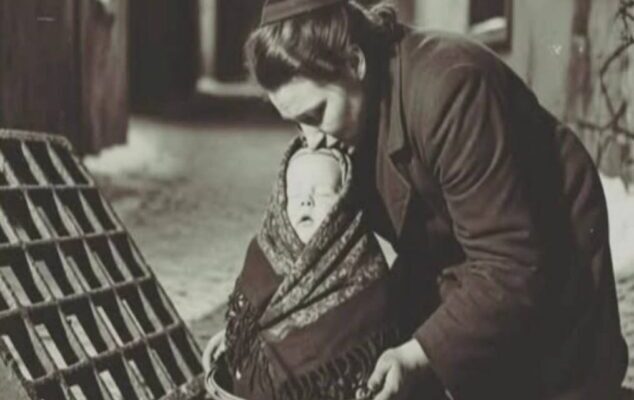
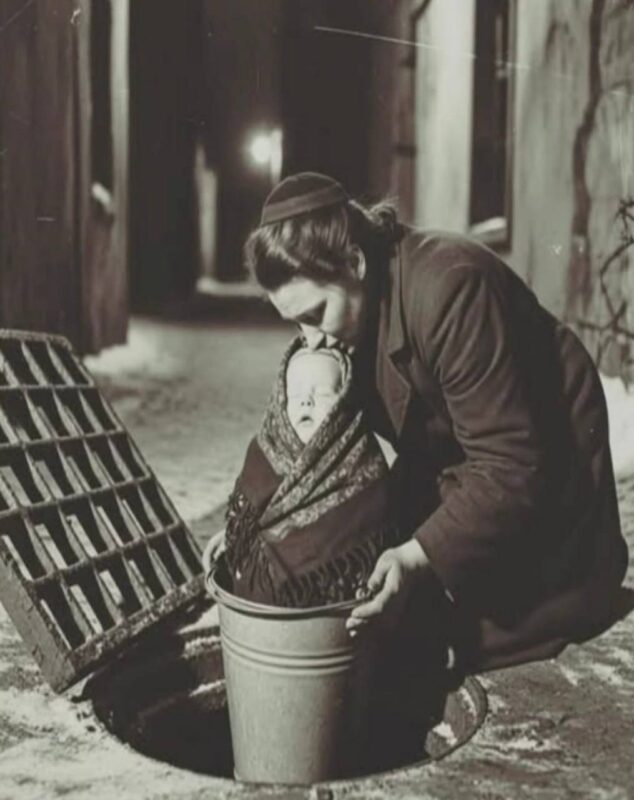
On a brutal night, so cold that even the stones cracked, the mother wrapped her baby in the only protection she had—a thin shawl—and placed him inside a metal bucket.
His hands were shaking, not from the freezing air, but from the weight of the moment.
As the child was lowered down a manhole into the darkness below, she whispered the last words he would ever hear from her: “Grow where I cannot.”
She didn’t get off. She stayed behind, fully aware of what awaited her.
He had chosen his destiny, so that his son would have a future.
The worker who received the bucket in the shade held the baby against the stench and darkness.
Navigating the labyrinth of tunnels, he carried the child beyond the ghetto walls and towards a fragile freedom.
Against all odds, that baby survived.
The mother’s name was never recorded. There is no photograph of her face, nor a grave to mark her sacrifice.
History, in its cruelty, swallowed up his identity.
But her gesture remained, not in documents or monuments, but in the breath of life of the boy she saved.
This boy grew up and became a man. He survived the war, built a life, and grew old—proof of his mother’s last gamble.
Decades later, with his hands marked by time, he returned to Lviv.
Standing in front of a rusty manhole cover, he placed a single red rose on the metal that once opened onto the sewers below.
“This,” he whispered, “was my beginning.”
Ali, sobre o pavimento rachado acima dos túneis que o haviam conduzido à vida, ele homenageou a mãe que nunca pôde lembrar.
A mulher que lhe deu tudo ao entregá-lo. A mãe cujo amor não precisou de nome para durar.
Sua história, quase perdida, ecoa através das gerações. Lembra-nos que, mesmo nas circunstâncias mais desesperadoras, o amor humano encontra formas de desafiar a destruição.
Que, diante do aniquilamento, o instinto de uma mãe em proteger seu filho pode brilhar mais forte que a mais sombria crueldade.
O Holocausto deixou para trás seis milhões de silêncios — nomes, vozes e vidas apagadas.
E, no entanto, dentro desse silêncio existem histórias como esta, sussurradas por sobreviventes, lembradas em fragmentos e transmitidas como prova de que o amor pode sobreviver mesmo onde a vida não pode.
O homem que um dia esteve naquele balde não era apenas um sobrevivente. Ele era o testemunho vivo da decisão, do sacrifício e da esperança de sua mãe.
E, ao retornar ao lugar onde a história dela terminou e a sua começou, ele garantiu que aquele amor — não registrado, sem nome, mas eterno — jamais fosse esquecido.
Alguns atos de coragem são lembrados com monumentos. Outros vivem na memória, em palavras sussurradas e nas vidas que protegeram. Este foi o dela.
O ar estava denso de fumaça, do tipo que se agarra aos pulmões e queima os olhos.
As chamas crepitavam pelas árvores e rasgavam a terra seca, devorando tudo em seu caminho.
Para os bombeiros que combatiam o inferno, era mais um dia de escolhas impossíveis — casas a proteger, famílias a evacuar e o fogo implacável que se recusava a ser contido.
Em meio a esse caos, o olhar de um bombeiro captou algo inesperado. Encolhida à beira da floresta em chamas estava uma pequena figura trêmula.
Não era uma pessoa, mas um cachorro — com o pelo chamuscado, o corpo tremendo e os olhos arregalados de medo.
Sozinho, desorientado e cercado de fumaça, o animal parecia mais um fantasma do que uma criatura viva.
O bombeiro não hesitou. Colocando o pesado equipamento no chão, ajoelhou-se e estendeu a mão.
Por um instante, o tempo pareceu suspenso — o rugido das chamas desapareceu ao fundo, substituído pelo silêncio desesperado daqueles olhos castanhos.
O cão hesitou, dividido entre medo e instinto. Lentamente, cautelosamente, avançou.
Então, com um suspiro trêmulo, encostou-se ao peito do bombeiro, como se reconhecesse a segurança em meio à ruína.
Naquele frágil abraço, a devastação ao redor desapareceu. Restava apenas a compaixão.
Foi-lhe oferecida água, que o cachorro bebeu avidamente, a língua seca de calor e fumaça.
Um cobertor foi enrolado sobre seus ombros, protegendo seu pequeno corpo do ar acre.
Momentos depois, o bombeiro carregou o animal para a segurança, longe das nuvens negras sufocantes que quase o consumiram.
Para o homem de uniforme, foi apenas mais uma tarefa em um dia cheio de decisões urgentes.
Firefighters are trained to make life-or-death decisions every minute, and for him, reaching out to the dog was instinctive—another life worth saving. But for those who witnessed the scene, it was something much bigger.
It was a reminder.
A reminder that even in the heart of destruction, compassion can make room for hope.
A reminder that courage isn’t measured solely by homes saved or acres reclaimed from the flames—but also by the silent choice to embrace a frightened creature in need.
The dog’s future remains uncertain. His home may be lost, his family unknown.
But in that moment, none of that mattered. What mattered was that he was no longer alone, no longer just another victim of the disaster. He was seen, comforted, and protected.
For communities watching the fire’s devastation, the image of a soot-covered firefighter kneeling to rescue a terrified animal struck a chord.
Social media lit up with photos and stories, calling it a symbol of human kindness that persists.
Amidst walls of fire and red skies, a man and a dog reminded the world that compassion survives even in the harshest flames.
Disasters test people in ways they could never imagine.
They require sacrifice, courage and an almost impossible resilience.
And yet, sometimes it’s the smallest gestures that leave the deepest impressions—not the headlines about material losses, but the quiet gestures that reaffirm our belief in goodness.
For the firefighter, the day continued.
The fire still burned, houses needed saving, and exhaustion weighed heavily on every bone.
But somewhere in the chaos, a dog rested safely, his heart steady again, because one man chose to see him not as a distraction, but as a life worth protecting.
And perhaps that is the truest lesson hidden among the flames: even when the world burns, kindness endures.