A misty Sunday morning spread over the village of Beryozovka like a blurred watercolor.
The leaves of the birches rustled in the wind, and in the windows of the old house with the blue door there was still no light.
But that day Arkady Petrovich woke up before the roosters.
He had a nightmare: he was on the edge of a cliff, and below, in the thick fog, his granddaughter Alisa was calling to him.
Her voice trembled like a rope in the wind.
The old man opened his eyes; his heart was beating so fast it seemed to want to burst out of his chest.
“Something’s going to happen…” he whispered, looking at the cracked wallpaper in the room.
In the next room, behind a thin wall, slept 24-year-old Alisa.
Her glittery boots, left near the door, were a reminder of yesterday’s meeting with Maksim—her future husband.
Arkady Petrovich raised his granddaughter alone after her mother, Vera, disappeared from their lives, as if carried away by a storm.
He taught Alisa to read the stars, to make wild raspberry jam, and to believe that even in the darkest forest there is always a way.
Now the girl was about to move to the city, and the bitterness of loneliness bubbled in her soul.
In the trunk under the bed were the savings—money for an apartment for Alisa.
But how it hurt to imagine that those notes would separate them forever…
“Maybe you’ll come live with us, Grandpa?” Alisa would ask every week, hugging him around the neck. “We have a big apartment, and Maksim loves you!”
“No, granddaughter,” the old man shook his head, hiding the tremor in his hands. “My roots are here. The city is not for me.”
But that day, anxiety wouldn’t leave him. While Alisa slept, Arkady Petrovich chopped wood, lit the oven, and baked an apple pie—his favorite dish.
The smell of cinnamon and warm dough filled the house, but suddenly Grandpa stopped at the window.
On the windowsill hung a faded medallion—a gift from Verochka, his mother.
“Nonsense,” he thought, hiding the amulet in his pocket. “This is no time to dwell on the past.”
“Wow!” Alisa came running into the kitchen in a pink robe, her braids tousled over her shoulders.
— Grandpa, you’re a wizard! Just a wave of your hand and breakfast is ready!
She hugged him, and the old man felt her heart beat in time with his.
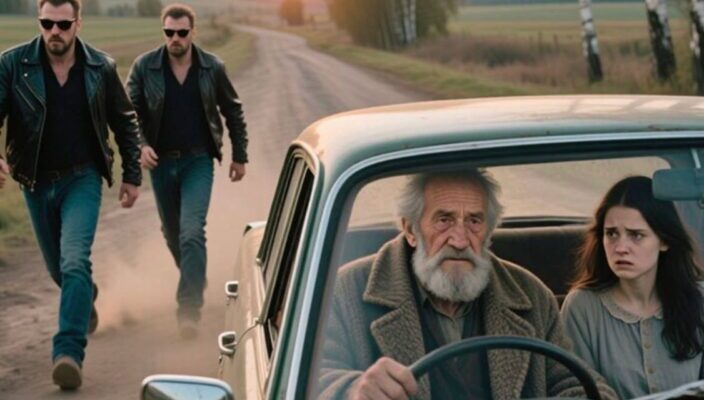
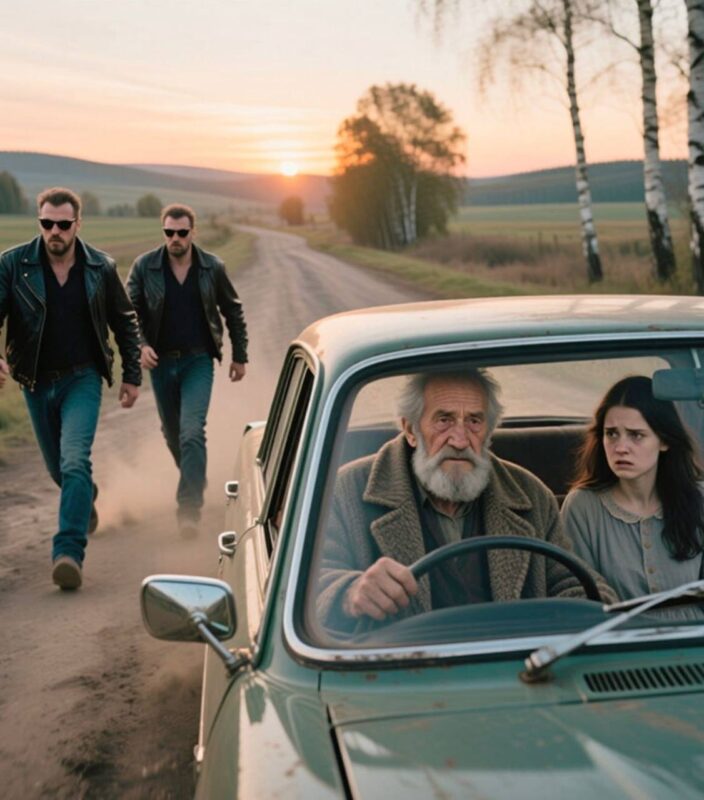
After coffee, they left in the 90s “Zhiguli”, rusty as a turtle’s shell.
Alisa, wrapped in her scarf, fell asleep with her head on her grandfather’s shoulder.
“Como naquela vez…” — Arkadi Petrovich lembrou-se de quando, doze anos atrás, a levou do hospital depois que ela teve pneumonia. Ele rezou a noite toda segurando suas mãos quentes.
De repente — um choque! O carro sacudiu como um cervo ferido.
Atrás, um “Gelandewagen” preto bateu, e três homens saíram.
Rostos escondidos por máscaras, mas os olhos frios como lâminas.
— Sai daí, velho! — gritou o chefe, abrindo a porta.
Arkadi Petrovich congelou. No retrovisor, viu um dos bandidos puxar Alisa pelos cabelos.
— Onde está o dinheiro?! — rugiu o homem, sacudindo o avô pelo colarinho. — Ontem você estava no banco para pegá-lo!
— Que dinheiro? Eu só recebia aposentadoria…
— Não minta! — O golpe atingiu a bochecha. O velho sentiu o gosto de sangue.
Alisa gritou quando mãos estranhas apertaram seu pulso.
Um dos ladrões abriu o zíper da jaqueta dela e então… parou.
Seus olhos se arregalaram, como se tivesse visto um fantasma.
— O que… o que é isso que você tem? — sussurrou, apontando para o peito de Alisa.
No pescoço, sob o suéter, aparecia um medalhão em forma de lua — igual ao do bandido.
— O quê? — perguntou Alisa assustada, tentando cobrir o peito.
— Um amuleto! — gritou o homem, recuando. — Onde você conseguiu isso?!
Arkadi Petrovich aproveitou a confusão, se libertou e correu para o meio da estrada. Mãos levantadas ao céu, a voz num grito:
— Socorro! Eles vão nos matar!
Por sorte, de uma curva surgiu um Ford branco.
O motorista freou bruscamente, e os bandidos, xingando, correram para o próprio carro.
A última coisa que o avô ouviu foi o chiado dos pneus e o grito do chefe:
— Vamos! Mas ainda voltaremos!
À noite, no apartamento de Alisa, Maksim servia chá, tentando acalmar o tremor nas mãos da garota.
— Precisamos chamar a polícia, — insistiu ele.
— Mas por que ele teve medo do meu amuleto? — Alisa apertou o medalhão na mão. — Isso não é coincidência…
Na manhã seguinte, as notícias informaram: três ladrões foram presos perto da estação.
Alisa pulou do sofá quando na tela apareceu o rosto do chefe — um homem alto com uma cicatriz na bochecha.
No peito dele, sob a camisa aberta, brilhava o medalhão lunar.
— É ele! — gritou. — Vovô, é ele!
Decidida a desvendar o mistério, Alisa foi ao orfanato nº 12, onde se descobriu que Daniil Sokolov — nome do ladrão — havia sido criado. As portas da instituição cheiravam a tinta velha e medo infantil.
— O menino foi abandonado na maternidade, — contou a diretora, folheando registros amarelados. — A mãe o rejeitou logo após o parto. Dizem que ela estava presa por roubo… Chamava-se Vera. Sobrenome — Sokolova.
Alisa estremeceu. “Vera Sokolova… minha mãe”.
— E este amuleto? — perguntou com voz trêmula, mostrando seu medalhão.
— Ah, não me lembro… — suspirou a mulher. — Mas lembro que ela tinha uma corrente com a lua. Foi tomada dela na prisão, mas ela implorava para deixá-la para o filho…
Alisa voou para casa sobre asas de terror e esperança.
Na mente uma só ideia: “Daniil é meu irmão. O vovô sabia disso”.
“Tell me the truth!” he demanded, cornering Arkady Petrovich in the kitchen. “Why did you hide the fact that I had a brother?!”
The old man sat down, looking dejected. His eyes were dark like two blueberries.
“Your mother…” he began, struggling to find words. “She was light until her soul darkened.”
Eighteen years ago, she was arrested for robbing a jewelry store.
In prison, she gave birth to Daniil… But I thought he had died! He was taken to the orphanage, and Vera…” her voice broke. “Died of tuberculosis when you were five.”
Before he died, he wrote a letter: “Forgive me, Alisa. I leave you the amulet—it will protect you from the darkness.”
Alisa fell to her knees, clutching the medallion to her chest.
Now everything made sense: why his mother carried that symbol, why his grandfather feared the city, why he wanted to protect it from all harm.
“And Daniil?” he whispered.
“He chose his mother’s path,” Arkady Petrovich smiled bitterly. “He’s already in his third term… Don’t look for him, granddaughter. It’s useless.”
But Alisa didn’t listen. The next day, she went to the prison.
Behind the glass stood Daniil—thin, with shadows in his eyes, but with the same look as hers.
“You… you’re my brother,” he said, reaching for the glass.
He turned away, but Alisa saw his fingers tighten around the locket.
“Mother asked me to give you away,” he whispered, “that she loved you both. And she asked… for forgiveness.”
Daniil remained silent. But as she left, she heard a whisper:
— Tell Grandpa… thank you for saving her back then.
It turned out that years ago, Arkady Petrovich rescued Vera from a crime boss, but she returned to her former life. This saved Alisa, but not Daniil.
Today Alisa lives in her house outside the city. Next door is Arkady Petrovich’s land.
Together they plant potatoes, and at night the grandfather reads to his grandson—Alisa and Maksim’s son—tales about lunar amulets.
Sometimes someone knocks on the door. It’s Daniil. Free, he works as a carpenter and learns to forgive himself.
In Alisa’s box are two medallions—lunar and solar.
One from his mother, one from his brother. And every time he touches them, he feels goosebumps on his skin.
Not of fear. Of hope.
Because even in the darkest corners of the soul, there is always light. You just have to reach out.